
Baby Carrier or Baby Sling – Which One Should You Choose at the Beginning?
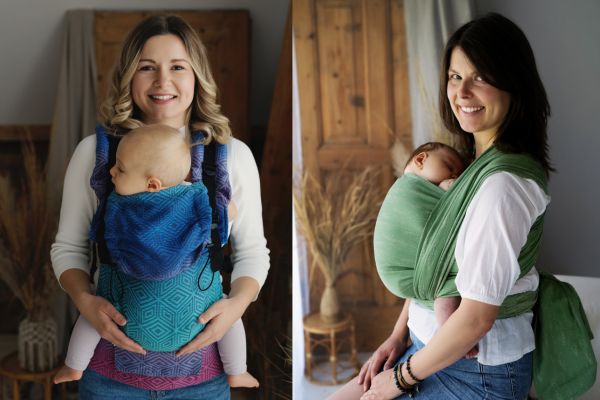
Baby Carrier or Baby Wrap – Which One Should You Choose at the Beginning?
Babywearing is much more than just a way to move around with your little one. Above all, it is about closeness, building a strong bond, a sense of security, and natural support for your baby’s development from the very first days of life. It’s no surprise that more and more parents choose either a baby wrap or an ergonomic baby carrier.
At the beginning of this journey, however, one question often arises: what is better – a baby carrier or a baby wrap? And what should you choose at the start, when everything is new and your baby’s needs change so quickly?
Both solutions are safe and ergonomic when used correctly. They differ, however, in how they are put on, how precisely they can be adjusted, and the stage at which they work best. Below you’ll find a practical comparison to help you choose the option best suited to your family.
Baby Wrap – A Natural Start from the First Days of Life
A baby wrap is one of the most natural and versatile tools for carrying a baby. When tied correctly, it allows the fabric to be perfectly adjusted to both the baby’s and the parent’s body, ensuring an ergonomic position and full support along the entire length of the baby’s back.
While tying the wrap, the fabric is tightened directly around the baby, so your little one is gently but securely held, making carrying stable and comfortable.
Why Is a Baby Wrap a Good Choice at the Beginning?
- can be used from the very first days of life,
- adapts perfectly to a very small newborn,
- supports the natural position of the spine and hips,
- allows for closeness and quick response to your baby’s needs,
- offers great flexibility in adjusting carrying to the baby’s current stage of development.
For many parents, a wrap – especially a stretchy wrap – is the first step into babywearing. Although it requires learning how to tie it, it quickly becomes intuitive, and the skill pays off for many months or even years of carrying (in the case of a woven wrap).
Ergonomic Baby Carrier – Everyday Comfort and Speed
An ergonomic baby carrier is a ready-to-use solution that can be put on much faster than a wrap. It is especially appreciated by parents who need a simple and convenient way to carry their baby in everyday situations.
Putting on a carrier takes just a moment – you fasten the waist belt, place the baby inside, buckle the straps, and tighten the shoulder straps. This solution works particularly well if you leave the house often or carry your baby multiple times a day.
When Is an Ergonomic Baby Carrier a Good Choice?
- it can be used from the first days of life (in models suitable for newborns, such as Prime or Cross Hybrid carriers),
- when quick and easy putting on and taking off is important,
- for frequent outings, walks, and travel,
- when carrying lasts longer and the baby becomes heavier.
A good ergonomic baby carrier ensures the correct baby position – the so-called “M position” – and proper support for the spine. Compared to a wrap, however, it offers less opportunity for very precise adjustment to a tiny newborn.
When Does a Wrap Work Best, and When Is a Carrier Better?
A baby wrap works best in calm, everyday situations, especially during the first weeks and months of a baby’s life. It is ideal for:
- carrying your baby around the house while doing daily activities,
- helping your baby fall asleep and nap thanks to the soft, cocoon-like support,
- relaxed walks,
- building closeness and calming your baby, especially newborns and young infants.
An ergonomic baby carrier is perfect when speed, comfort, and carrying stability matter most. It is an ideal solution:
- while shopping and running errands,
- during trips and travel, including airplanes and airports,
- for longer walks and active outings,
- in the mountains, during trekking, and other outdoor activities,
- anywhere you need to put the carrier on and take it off quickly.
This comparison shows that wraps and carriers complement each other perfectly – a wrap works best in calm, everyday situations, while a carrier shines where mobility and quick action are needed.
Wrap or Carrier – Key Differences in Practice
Fit and Adjustment
A wrap offers almost unlimited adjustment possibilities. During tying, the fabric is tightened directly on the baby, gently wrapping them and adapting precisely to their body. This is especially important for newborns and very small babies.
A carrier has adjustable panels and shoulder straps but is a more “universal” solution, designed to fit a wide range of users.
Ease of Use
The carrier wins in terms of speed – the whole process takes just a moment. A wrap requires learning and attention, especially at the beginning. You need to remember to tighten the fabric properly and position the baby correctly. Once mastered, however, tying becomes natural and quick.
Carrying Stages
A wrap – especially a woven one – can accompany your child from the first days of life until the end of the babywearing period, even into preschool age. Ergonomic carriers are usually designed for children from birth up to around 3 years, while special models for older children allow carrying up to 5–6 years.
Carrying Style
A wrap offers a wide variety of tying techniques and carrying positions – front, hip, and back carries. A carrier allows front (tummy-to-tummy) or back carrying in a comfortable and universal way, suitable for both mothers and fathers.
What Should You Choose at the Beginning?
If you are just starting your babywearing journey, a baby wrap – especially a stretchy wrap or a well-chosen woven wrap – is an excellent choice at the beginning. It provides maximum adjustment, closeness, and comfort for both baby and parent.
An ergonomic baby carrier works very well as a first choice or as the next step, and also as a complement to a wrap – especially when your baby becomes heavier and you need a quick and convenient everyday solution.
Summary
There is no single, universal answer to the question: carrier or wrap? The best solution is the one that suits your family’s needs, your baby’s stage of development, and your lifestyle. Many families successfully use both options – starting with a wrap and later choosing a carrier, or opting for a carrier that works from birth up to around 3 years.
The most important thing is one: safe, ergonomic babywearing and the closeness your child gains from the presence of a parent.
Recommended

Baby Sling Dark Aurora Cube size 6

Baby Sling Inky Cube size 6

Baby Sling TENCEL™ Iris Cube size 6

Baby Sling Jade Cube size 6

Baby Sling TENCEL™ Atmosphere Cube size 6

Baby Sling Roselily Cube size 6

Baby Sling Linen Lightness size 6

Baby Sling TENCEL™ Joy of life size 6

Baby Carrier Prime Gray Moonstone v3

Baby Carrier Prime Platinum Miles v3

Baby Carrier Prime Adventure Miles v3

Baby Carrier Prime Natural Miles v3

Baby Carrier Prime Slate Moonstone v3

Baby Carrier Prime Umber Lightness v3

Baby Sling Umber Lightness size 6

Baby Carrier Prime Re Rocky Miles v3

Baby Carrier Prime Linen Miles v3

Baby Carrier Prime Calm Miles v3

Baby Sling TENCEL™ Calm Cube size 6

Baby Sling Bitter Cube size 6

Baby Carrier Prime Sage Moonstone v3

Baby Carrier Prime Linen Matcha v3

Baby Carrier Prime Linen Freddo v3

Baby Sling Emerald Path size 6

Baby Sling Brown Path size 6

Baby Carrier Prime Ocean Wildness v3
