Baby Facing Out in a Sling – Why It’s Not Recommended

Baby Facing Out in a Sling – Why It’s Not Recommended
Many parents, when their baby starts looking around with curiosity, wonder whether it’s possible to carry a baby facing out in a baby sling.
It may seem tempting – the baby sees more, and the parent has free hands.
However, babywearing experts and physiotherapists agree: a baby sling is not designed for carrying a baby facing outward.
Why? Because this position neither supports the baby’s healthy development nor provides comfort and a sense of security.
Lack of Ergonomics – the Baby “Hangs” on the Crotch
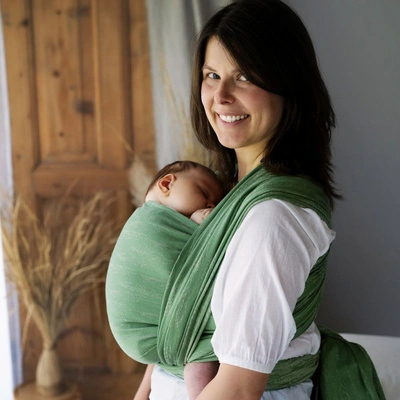
A baby sling is designed to wrap around the baby’s body and evenly support it along its entire length – from the neck to the bottom.
This allows the baby to adopt a natural, slightly rounded C-shaped spine and the M-position of the legs (knees higher than the bottom).
When carrying a baby facing out, this natural alignment is impossible.
The baby’s weight rests on the crotch, and their back becomes unnaturally straightened. The spine and hips lose proper support, which can lead to strain – especially for infants whose musculoskeletal systems are still developing.
Impossible to Tighten the Sling Correctly
A baby wrap or sling only works properly when it is snug and well-adjusted to both the baby’s and the wearer’s bodies.
In the forward-facing position, this is not possible – the fabric does not wrap the baby’s back, the head lacks support, and the position becomes asymmetrical.
As a result, the baby is not properly supported, and their weight is distributed unevenly.
For the parent, this position is also less comfortable – the centre of gravity shifts forward, putting more pressure on the back and shoulders.
Too Many Stimuli and Lack of Security
When carried facing the world, the baby’s entire attention is exposed to the environment – sounds, lights, movement, and people.
The baby cannot snuggle into the parent, turn away, or hide when feeling tired or overwhelmed.
For a small baby who is still learning to process the world, such constant stimulation can be too intense.
In the tummy-to-tummy position (baby facing the parent), the baby can choose – to look around and explore, or to rest their head and feel safe in their caregiver’s arms.
How to Carry So the Baby Can See More
If your baby is becoming more curious about the world and you want to let them observe their surroundings, there are other, healthy and ergonomic ways to do so:
Hip carry – perfect for babies who already hold their head up confidently and want to look around from the side.
You can do this in a ring sling or a long woven wrap.Back carry – once your baby is older (usually around 6 months), you can safely carry them in a woven wrap or an ergonomic baby carrier on your back.
The child can see a lot while still feeling close and supported.
Summary – A Sling Is for Closeness, Not Exposure
A baby sling is meant to keep your child close to your body in a way that supports their development and gives them a sense of security.
Carrying a baby facing out disturbs these key elements – it strains the spine, exposes the baby to excessive stimuli, and deprives them of the ability to retreat into the safety of the parent’s embrace.
That’s why the best and safest way to carry your baby in a sling is facing you.
When your child becomes more curious about the world, you can simply switch to a hip or back carry – still close, still safe, but with a broader view.
Recommended

Baby Sling Cloudy Cube size 6

Baby Sling Inky Cube size 6

Baby Sling TENCEL™ Iris Cube size 6

Baby Sling Jade Cube size 6

Baby Sling TENCEL™ Rocky Cube size 6

Baby Sling TENCEL™ Aurora Cube size 6

Baby Sling TENCEL™ Atmosphere Cube size 6

Baby Sling Roselily Cube size 6

Baby Sling Fleeting Nature size 6
Baby Sling Gray Moonstone size 6
Baby Sling Slate Moonstone size 6

Baby Sling TENCEL™ Calm Cube size 6

Baby Sling Bitter Cube size 6

Baby Sling Linen Lotus Breeze size 6

Baby Sling Steel Whisper size 6

Baby Sling Lotus Bloom size 6

Baby Sling Hazy Love Rose size 6

Baby Sling Emerald Path size 6

Baby Sling Brown Path size 6