
Frequently Asked Questions about Ergonomic Baby Carriers – Practical Answers
1. From when can you use an ergonomic baby carrier?
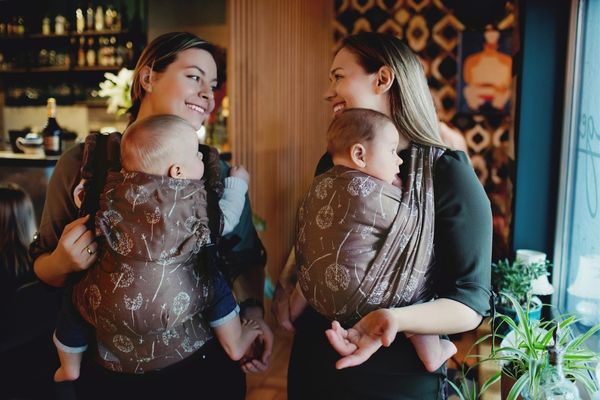
Most ergonomic baby carriers can be used from birth, provided they are properly adjusted to the size of the newborn – meaning they allow adjustment of the panel’s height and width, provide head support, and enable the ergonomic “tummy-to-tummy” position with correct alignment – the M-position. The minimum baby weight is usually around 3.5–4 kg.
2. Until what age can a child be carried in a carrier?
Most adjustable carriers allow carrying up to 15–20 kg (approx. 2–3 years), while toddler or preschooler models can be used up to 30 kg (approx. 4–6 years).
3. What is the difference between an ergonomic carrier and a “non-ergonomic carrier”?
An ergonomic baby carrier ensures a natural and healthy position – the so-called M-position, where the legs are spread and the knees are higher than the bottom.
In a “non-ergonomic carrier,” the child sits on the crotch without proper support for the thighs and buttocks, which may put pressure on the spine and cause improper hip alignment.
4. What types of ergonomic baby carriers are there?
-
Classic ergonomic carriers – fully adjustable with buckle straps
-
Hybrid carriers – waist belt with a buckle, shoulder straps for tying
-
Mei tai carriers – all straps for tying
-
Toddler/preschooler carriers – larger models for older children
5. Is a carrier suitable for a newborn?
Yes, but only if it is an ergonomic baby carrier designed for use from birth and equipped with proper adjustment options.
The key is that the panel allows adjustment of both width and height, so it can be precisely adapted to a small newborn.
Equally important is gentle and stable support for the baby’s head and neck – crucial in the first weeks of life.
It is best to choose models that:
– allow the “tummy-to-tummy” position,
– support the natural M-position,
– are made of soft, breathable fabrics suitable for a newborn’s sensitive skin.
6. Should you carry your baby on the front or back?
Newborns and infants are best carried on the front, in the “tummy-to-tummy” position, which provides closeness, a sense of security, and easy monitoring of the baby.
Older babies, usually from around 8–10 months, can also be carried on the back – this position is particularly comfortable during longer walks, hikes, or daily household activities.
The choice depends on the child’s age, stage of development, and the parent’s preference – the most important thing is to maintain an ergonomic position and comfort for both.
7. Can you carry a baby facing outwards?
This position is not recommended, as it does not support ergonomic posture, and the baby is exposed to overstimulation and spinal strain. Safer positions are “tummy-to-tummy” and back carrying.
8. How to choose a carrier for your body type?
Little Frog baby carriers have a wide adjustment range and fit both petite and larger body types. A well-fitted carrier does not dig in, distributes weight evenly, and ensures comfort for many hours.
9. What is the difference between a buckle carrier and a hybrid carrier?
In a classic buckle carrier, all straps are fastened with buckles. In a hybrid carrier, the waist belt fastens with a buckle, while the shoulder straps are tied like a wrap – offering greater flexibility and comfort.
10. What materials are best for baby carriers?
Natural and breathable:
-
Cotton – universal, soft, and durable
-
Linen – airy, ideal for summer
-
TENCEL™ – very soft, cool, and gentle on sensitive skin
11. Are ergonomic baby carriers safe?
Yes – as long as they are properly adjusted and used correctly. Ergonomic baby carriers are designed to support healthy child development and provide comfort for parents.
For safe babywearing, remember these rules:
– the baby must always have clear airways,
– the carrier must be adjusted to the child’s height and stage of development,
– the baby’s position should be ergonomic – legs spread, knees higher than the bottom, back rounded (the M-position),
– regularly check the carrier’s condition – buckles, straps, and seams should be intact.
Safety also means mindful babywearing – read the instruction manual and, if in doubt, consult a certified babywearing consultant.
12. How long can I carry my baby without a break?
There is no single rule – the most important factor is the comfort of the baby and the person carrying. Newborns should be taken out regularly for feeding and diaper changes. Older children can be carried for several hours a day if they show no signs of discomfort.
13. How to care for a baby carrier?
It is recommended to wash according to the instructions – usually at 30°C, without bleach. Stains can be wiped with a damp cloth. Avoid tumble drying.
14. Is one carrier enough for the whole babywearing period?
Yes – if you choose an adjustable model that grows with your child. Thanks to panel width and height adjustment, such a carrier can be used from the first days of life up to around 3 years.
Examples include our Prime and Cross Hybrid models – fully adjustable carriers that “grow” with your baby and provide comfort for both the child and the wearer.
For bigger and heavier children, it is worth considering a toddler or preschooler carrier, which is adapted to higher weight and height while still ensuring an ergonomic position.
15. What types of ergonomic baby carriers are there by age?
-
Newborn & infant carriers – designed for use from the first days of life. They allow precise adjustment of panel width and height, gentle head support, the M-position, and close contact with the parent – especially important in the first months.
-
Toddler carriers – larger models for older babies (usually from about 12 to 36 months). Perfect for daily walks and longer trips, distributing the child’s weight evenly.
-
Preschooler carriers – for preschool-age children (up to 5–6 years). A great alternative to a stroller during travel, excursions, or hikes in more challenging terrain.
The right carrier depends on the child’s height, weight, stage of development, as well as the parent’s comfort and preferences.
Recommended

Baby Carrier Cross Hybrid Natural Miles

Baby Carrier Cross Hybrid Natural Wildness

Baby Carrier Preschooler - Adventure Miles

Baby Carrier Cross Hybrid Viridian Miles

Baby Carrier Prime Gray Moonstone v3

Baby Carrier Prime Platinum Miles v3
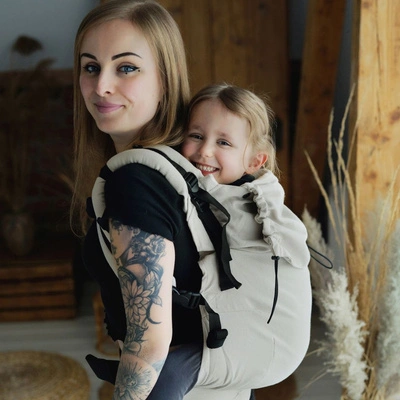
Baby Carrier Preschooler - Beige Moonstone

Baby Carrier Prime Calm Miles v3

Baby Carrier Prime Linen Matcha v3
