
How to Safely Carry a Newborn in a Baby Sling? Complete Guide for Parents
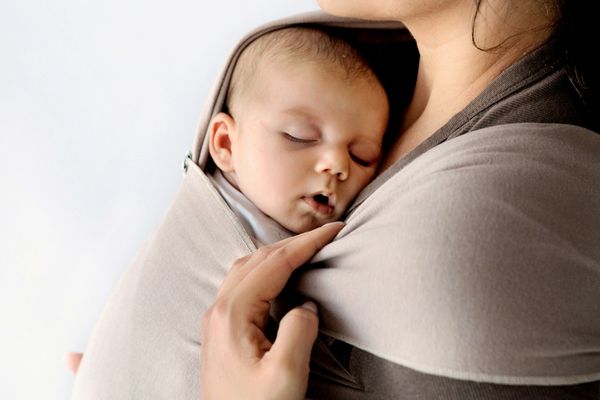
Is it safe to carry a newborn in a sling?
Yes, carrying a newborn in a sling is safe, as long as the sling is properly tied and snug, and the baby is positioned correctly.
Little Frog slings are made from certified fabrics Oeko-Tex Standard 100, free from harmful substances, and allow ergonomic positioning of the baby – with support for the head, spine, and hips.
Key principles are: back in natural curve (the letter C), legs in frog / M position, and clear airways.
Additionally, always remember to:
keep the baby at kiss-height – their head should be close enough to your chin,
regularly check that the baby’s chin is not resting on the chest, ensuring unobstructed breathing,
use carries suitable for newborns (e.g. pouch carry, kangaroo carry).
A properly tied sling is not only safe but also supports bonding, helps regulate the baby’s body temperature, and helps them feel as secure as in a parent’s arms.
How to position a baby in the sling for healthy hips and spine?
The baby should be positioned to mimic the natural posture they would take in a parent’s arms.
The most important guidelines are:
Frog position (M shape) – knees higher than the bottom, thighs gently spread, feet slightly pointed outward.
Spine in natural curve (C shape) – the back should form a soft arch.
Kiss-height – baby’s head at parent’s chest height, so you can kiss it without bending over.
Full support – sling fabric should be spread from the baby’s neck to under the bottom and to the knee pits, to support the body evenly.
Clear airways – baby’s face always visible; nose and mouth not covered, chin not pressed to chest.
Head stabilization – for newborns, the top edge of the sling should gently support the neck but not press.
This positioning supports healthy development of the hips and spine in line with recommendations by orthopaedists and organizations like the International Hip Dysplasia Institute.
It also ensures baby’s safety and parental comfort through even weight distribution across shoulders and hips.
Does the sling support correct hip development (frog / “M” position)?
Yes. A properly tied sling holds the baby in the natural M or frog position, where knees are higher than the bottom and thighs are gently spread.
This posture:
promotes proper shaping of the hip socket,
is recommended by orthopaedists and the International Hip Dysplasia Institute for hip dysplasia prevention,
provides even support of the thighs along their full length, without pressure on the crotch or spine,
allows the baby to move legs freely, supporting natural joint development.
Wearing in this position not only supports hip health but gives the baby a sense of safety and closeness important in the first months of life.
Can you use a sling from the very first days of life?
Yes. The sling is safe from birth if the baby is healthy and there are no medical contraindications.
It is best to choose a soft woven sling or an stretchy sling that adapts to the bodies of both baby and parent, and learn a basic carry – e.g. pouch or kangaroo carry (see sling instruction manual).
Starting carry from the first days:
builds bonding and emotional connection, giving the baby a sense of security,
helps regulate body temperature and breathing rhythm,
makes breastfeeding easier and calms the baby, especially in the early weeks post-birth,
supports the parent – allows hands free and better response to the newborn’s needs.
It’s worth using the sling tying instructions or support from a certified babywearing educator to ensure correct position and maximum comfort from the beginning.
How long can a baby be carried during the day?
There is no rigid limit – you can carry the baby as long as it is comfortable for both baby and parent.
Important things to consider:
taking breaks for feeding, changing, and repositioning,
regularly checking for clear airways and that the baby is not overheating,
adjusting carrying time according to the baby’s needs and your own comfort.
A properly tied sling distributes weight evenly, so you can carry for several hours a day without excessive strain on your back.
Many parents use the sling at different times – during walks, naps, or doing chores – treating it as a natural extension of closeness, not a strict schedule.
Does wearing in a sling help with colic and reflux?
Yes. The closeness to the parent, warmth, and gentle motion in the sling can alleviate symptoms of colic, helping the baby calm down and fall asleep more easily.
Wearing in a upright position also supports natural digestion and can reduce reflux issues by facilitating the movement of food through the stomach and preventing stomach contents from coming back up.
However, remember:
every baby reacts individually,
it’s essential to use a proper sling tying technique with support for the head and free airways,
if colic or reflux symptoms are severe, always consult a pediatrician.
Sling carrying is not a substitute for medical treatment, but it can be a valuable support in daily care, giving the baby safety and comfort in challenging moments.
From when can you carry a baby on your back?
You can start back carrying when:
the baby holds their head steadily (usually around 4–6 months),
the parent feels confident with front carries and comfortable handling the sling.
Back carries – like the simple backpack carry – are especially comfortable with older, heavier babies because:
they distribute weight better across the back and hips,
allow the baby to see the world over the parent’s shoulders, which satisfies their curiosity,
give the adult more freedom during daily tasks or long walks.
Safety tip:
It’s good to try back carrying under the guidance of a babywearing educator or with the presence of another person.
Using a mirror can help check that the sling is properly tied and supports the baby along the full length.
Does a sling put strain on the parent’s back?
A properly tied sling does not strain the spine – on the contrary, it helps distribute the baby’s weight evenly across shoulders, back, and hips.
Wearing in a sling is far more comfortable than carrying long periods in arms, because the fabric acts as a natural “support for the back,” helping maintain good posture and reducing tension in the lower back.
Proper adjustment and spreading of the fabric increases comfort even during long wearing sessions.
Many parents emphasize that a well chosen sling allows them to enjoy closeness with their baby without feeling overloaded.
Tip:
For maximum comfort, choose the right sling size and learn several carries (e.g. Front Wrap Cross Carry or kangaroo carry) that let you adjust comfortably and distribute weight optimally.
Can you breastfeed in a sling or Little Frog carrier?
Yes. Breastfeeding in a sling or Little Frog carrier is possible and comfortable, especially in an upright position.
You just need to gently loosen the sling or the carrier’s shoulder straps so the baby is positioned at breast height and has easy access to milk.
While breastfeeding, remember these guidelines:
Keep airways clear – the baby’s face should be visible, nose and mouth not blocked by fabric.
Support the head and back of the baby to maintain a stable and ergonomic position.
After feeding always retighten sling or carrier straps to restore proper support and safe positioning of the baby.
Breastfeeding in a sling allows you to nurse discreetly while walking, traveling, or in public, while maintaining closeness and the baby’s sense of security.
Tip:
The most comfortable carries for breastfeeding are e.g. double X or ring sling, because they allow quick loosening and re-tightening without fully undoing the sling.