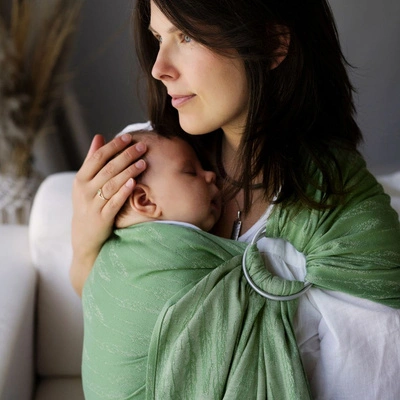
Ring sling – how to use, tighten, and wear it? A guide and FAQ for parents
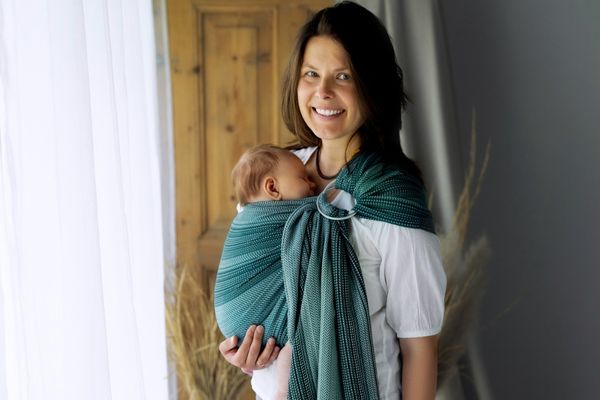
1. What is the difference between a ring sling and a long woven wrap?
A ring sling differs both in its construction and how it’s used. Instead of a long piece of fabric that you need to tie yourself, it has two strong aluminum rings sewn in. The fabric is threaded through the rings to create an adjustable “loop.” This makes putting on a ring sling quick and intuitive – simply pull the fabric through the rings and tighten it strand by strand to perfectly fit the sling to both your body and your baby.
A long woven wrap, on the other hand, offers more versatility – you can carry your baby in many ways: on your front, hip, or back, using different symmetrical ties that evenly distribute the baby’s weight across both shoulders. A ring sling works differently – it’s asymmetrical, with the baby’s weight resting mainly on one shoulder. That’s why it’s best suited for everyday, shorter situations: a quick trip to the store, calming the baby at home, or carrying them from the car to the house.
2. How to properly thread the fabric through the rings before placing your baby in the sling?
Before putting your baby in, it’s very important to prepare the sling correctly. Thread the fabric through the two rings to form an adjustable loop. Then spread the fabric neatly through the rings like an accordion – it should form a “fan,” evenly distributed across the entire width, without folds or twists.
This preparation allows the fabric to move smoothly when tightening, and each section (top, middle, bottom) will adjust independently. That makes it much easier to achieve a snug, supportive fit for your baby.
If the fabric bunches up into a “roll” or gets twisted in the rings, tightening will be harder and less precise. Take a moment to spread the material evenly – it will make the whole process smoother and more comfortable for both you and your baby.
3. How to put your baby in a ring sling?
To place your baby safely and comfortably in a ring sling, follow these steps:
Put the sling on your shoulder – Slip it over your head so the rings sit high on your collarbone or just below it (to the side of your chest). On the opposite hip, a “pocket” of fabric should form. Don’t leave too much slack – the pocket should be large enough to insert your baby and then adjust slightly.
Prepare the pocket – Spread the fabric open so it’s ready for your baby.
Place your baby in the sling – Hold your baby on your shoulder and gently slide them in from the side, always tummy to tummy. The baby’s bottom should sit deep in the fabric pocket. About one-third of the material should be between you and your baby, with the remaining two-thirds spread over the baby’s back up to the neck.
Spread the fabric – Smooth the material over the baby’s back, ensuring there are no loose areas. Pull the bottom edge under your baby’s bottom and between you for support.
Tighten strand by strand – Starting from the top edge down to the bottom, pull the fabric through the rings, adjusting each section. This ensures even support and snugness.
Check the position – Make sure your baby’s back is gently rounded, legs are in the “M” position, and their head is close enough to kiss. Your baby’s face should always be visible and free for easy breathing.
Following these steps ensures your baby sits securely and comfortably, while you enjoy freedom and convenience.
4. How to tighten a ring sling correctly?
Tightening is the key step for both comfort and safety. The most important rule: tighten strand by strand, not by pulling all the fabric at once. Always pull the fabric to the side, toward the rings, not downward – it will move much more smoothly.
Start with the top edge – this supports your baby’s neck and upper back. Tighten gently until snug but not restrictive.
Adjust the middle section – smooth the fabric and tighten to remove any slack or gaps.
Finish with the bottom edge – this creates the baby’s “seat,” supporting the bottom and thighs. It should be firm enough that your baby doesn’t slide down but not too tight to compress the tummy.
Each section of the fabric moves independently, which is why the fan-shaped setup is so important. Once tightened, check that your baby is supported from neck to knees, with legs in the natural “M” shape.
5. On which shoulder should you wear the ring sling?
You can wear a ring sling on either shoulder – it depends on your personal comfort. Try both sides and see which feels better.
Some tips:
If you’re right-handed, it’s often more comfortable to wear the sling on your left shoulder, keeping your right arm free.
If you’re left-handed, do the opposite.
Some parents switch sides occasionally to rest their shoulders and back.
The key is your comfort and your baby’s support – choose whichever side feels most natural for you.
6. From what age can you use a ring sling?
A ring sling is suitable from birth. Because the fabric provides firm support and allows for tummy-to-tummy carrying, it’s safe even for newborns.
It’s also great for older babies – it depends on your child’s weight and the type of sling:
Lighter, thinner slings are perfect for newborns and younger babies.
Thicker, denser slings are strong enough for toddlers (even 3–5 years old).
There’s no strict age limit – it’s all about your comfort, the fabric’s strength, and your child’s needs. Many parents use a ring sling throughout their entire babywearing journey, from the newborn stage to the toddler years.
7. Is a ring sling suitable for long walks?
A ring sling is very practical but remember that it’s asymmetrical – the baby’s weight is carried mainly on one shoulder. Therefore, it’s best for shorter periods of carrying, such as:
Around the house, when you need free hands,
Quick errands or short trips,
Calming or cuddling your baby,
Moving the baby from the car to the house or stroller.
For longer walks or all-day wear, a long woven wrap or ergonomic baby carrier will provide more comfort, as they distribute the weight evenly on both shoulders.
A big advantage of a ring sling is its compact size – you can always keep it in your bag or stroller. It’s perfect for travel, at the airport, or anytime your child suddenly needs closeness.
8. What if the fabric gets stuck in the rings and is hard to tighten?
Sometimes the fabric can “stick” in the rings, making it hard to adjust. This usually happens when the material isn’t spread properly or is twisted. To fix it:
Check the fabric in the rings – it should be spread in a fan, not rolled up.
Tighten to the side, not downward – pulling sideways helps the fabric glide smoothly.
Lift your baby slightly – supporting their bottom with your hand can release tension and ease adjustment.
Spread the fabric before each use – good preparation makes tightening much smoother.
Also, remember that new slings can be stiffer at first – after a few washes and uses, the fabric softens and moves more easily.
9. How to wear a ring sling in summer?
A ring sling is an excellent summer option – quick to put on, lightweight, and compact. It’s ideal for hot days when comfort and breathability matter most.
Some summer tips:
Choose breathable fabrics – blends with linen, bamboo, or TENCEL™ are cooler and wick moisture better than thicker cotton models.
Dress your baby lightly – the sling acts as an extra clothing layer, so a bodysuit or light top is often enough.
Choose light, airy clothing for yourself too.
Protect your baby from the sun – use a light hat or muslin cloth (but never cover their face).
Stay in the shade and avoid direct sunlight for too long.
These simple steps will help make babywearing in a ring sling safe and comfortable for both of you during warm weather.
10. How to wash and care for a ring sling?
To keep your ring sling in great condition for years, follow these care tips:
Always check the care label – different materials (cotton, linen, bamboo, TENCEL™) have different washing instructions.
Protect the rings before washing – put them in a sock or fabric bag, or wrap them in part of the sling to avoid hitting the drum.
Use gentle detergents – ideally those made for baby clothes. Avoid bleach and fabric softeners.
Wash in the machine on a delicate cycle at 30–40°C.
Do not tumble dry – hang or lay flat to dry, away from direct sunlight.
Proper care keeps your sling soft, safe, and comfortable – even after years of daily use.
11. Is a ring sling safe for newborns?
Yes – a ring sling is safe for newborns, provided the baby is positioned correctly and the sling is tightened properly. You can use it from the first days of life because the fabric provides full-body support and keeps your baby close.
Follow these safety rules:
Baby’s tummy should face the parent,
The back should be gently curved in a “C” shape,
Legs in the “M” position – knees higher than bottom, thighs well supported,
Face visible at all times, with clear airways and chin off the chest.
When used correctly, a ring sling is a completely safe way to carry a newborn, ensuring comfort, closeness, and bonding.
12. Can you breastfeed in a ring sling?
Yes – a ring sling is one of the most convenient ways to breastfeed discreetly. Simply loosen the fabric slightly and lower your baby so they are level with your breast. Always keep your hand supporting your baby’s head and make sure their airways remain clear.
After feeding, retighten the sling and reposition your baby higher, tummy to tummy, with rounded back and visible face.
Breastfeeding in a ring sling gives mothers freedom and privacy while keeping the baby close and calm.
Just remember: stay still during feeding and keep watching your baby to ensure safe breathing and swallowing.
Recommended

Ring sling Quartz - size M (2m)

Ring Sling TENCEL™ Iris Cube size M (2 m)

Ring sling Jade Cube - size M (2m)

Ring Sling TENCEL™ Rocky Cube size M (2 m)

Ring Sling TENCEL™ Aurora Cube size M (2 m)

Ring sling Bamboo Quartz - size M (2m)

Ring Sling Bamboo Zircon - size M (2 m)

Ring sling Zircon - size M (2m)

Ring sling Bamboo Misty Zircon - size M (2m)

Ring sling Malachite - size M (2m)

Ring sling Boleite - size M (2m)

Ring sling Jasper - size M (2m)

Ring Sling TENCEL™ Atmosphere Cube size M (2 m)

Ring sling Roselily Cube - size M (2 m)

Ring sling TENCEL™ Joy of life - size M (2 m)

Ring sling Fleeting Nature - size M (2 m)

Ring sling Gray Moonstone - size M (2m)

Ring sling Slate Moonstone - size M (2m)

Ring sling Linen Joy of life - size M (2 m)

Ring sling Umber Lightness - size M (2 m)

Ring sling TENCEL™ Calm Cube - size M (2 m)

Ring sling Bitter Cube - size M (2 m)
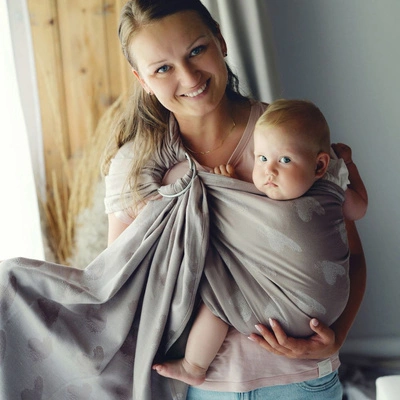
Ring sling TENCEL™ Hazy Love Drift - size M (2 m)

Ring sling Steel Whisper - size M (2 m)

Ring sling Lotus Bloom - size M (2 m)

Ring sling Hazy Love Rose - size M (2 m)

Ring sling Emerald Path - size M (2 m)

Ring sling Brown Path - size M (2 m)